Train With the Engineers Who Build These Systems
Specialized courses taught by the engineers who design and test gas turbines, combustion systems, and industrial AI. Ex-GE, PhD-led, field-proven. Delivered at your facility anywhere in the world, at a regional venue, in Cincinnati, or live online, in English or Arabic.
Already enrolled? Sign in to your courses and certificates
Training Where Your Team Needs It
We travel to deliver our courses for your team, at your facility or at a venue in the city that suits you, or you can bring your engineers to us in Cincinnati. Every course can be delivered in English or Arabic.
At Your Facility
Anywhere in the world
We travel to your plant, training center, or offices and teach your team on site. Examples and exercises are built around the units, fuels, and operating data your engineers work with every day.
- No travel for your team
- Content tailored to your fleet
- The most economical option for larger groups
At a Regional Venue
Istanbul · Dubai · Cairo · your choice
Prefer to send your engineers away from daily operations to focus? We run the course at a professional conference venue in a regional hub such as Istanbul, Dubai, or Cairo, or in another city you choose.
- A short flight from most Gulf capitals
- We arrange the venue and training logistics
- Trainees from several sites or companies can join together
In Cincinnati, USA
Our home base
Train where we are based. Greater Cincinnati is a center of the US jet-engine industry and home to GE Aerospace’s Evendale campus. Courses run at a professional conference venue in the Cincinnati area.
- Invitation letters provided for visa applications
- Plan early: US visa appointment waits vary by country
- Groups from one company or several
Live Online
Your time zone
Join one of our scheduled live cohorts, or book private live sessions for your team, timed around your working hours and time zone.
- Live with the instructor, not recorded lectures
- Private sessions for your team only
- Ideal for teams spread across sites

Your instructor
Dr. Bassam Abdelnabi
Ph.D. in Aerospace Engineering, with over a decade of leadership at GE Aerospace and GE Global Research in combustion system design and testing. Gas turbine combustion and DLE emissions specialist.
English or Arabic
نقدم التدريب باللغتين العربية والإنجليزية
Certificate for every trainee
Issued on completion of the course
Field-Grade Knowledge, Transferred Directly
Every course below is built around the decisions you actually face in the test cell and the field, not slides recycled from a textbook.
Practitioners, Not Lecturers
Taught by the engineers who design, test, and troubleshoot these systems: ex-GE, PhD-led, with patents in the field.
Field Experience, Not Textbook Theory
Courses distilled from decades of hands-on test-cell and field practice. You learn how these machines actually behave, not how the textbook says they should.
Small Cohorts, Direct Q&A
Limited seats keep every session interactive. Bring your hardest questions straight to the instructor.
Open for Enrollment
A flagship live cohort, and a design program offered two ways: join its live cohort or start on-demand tonight.
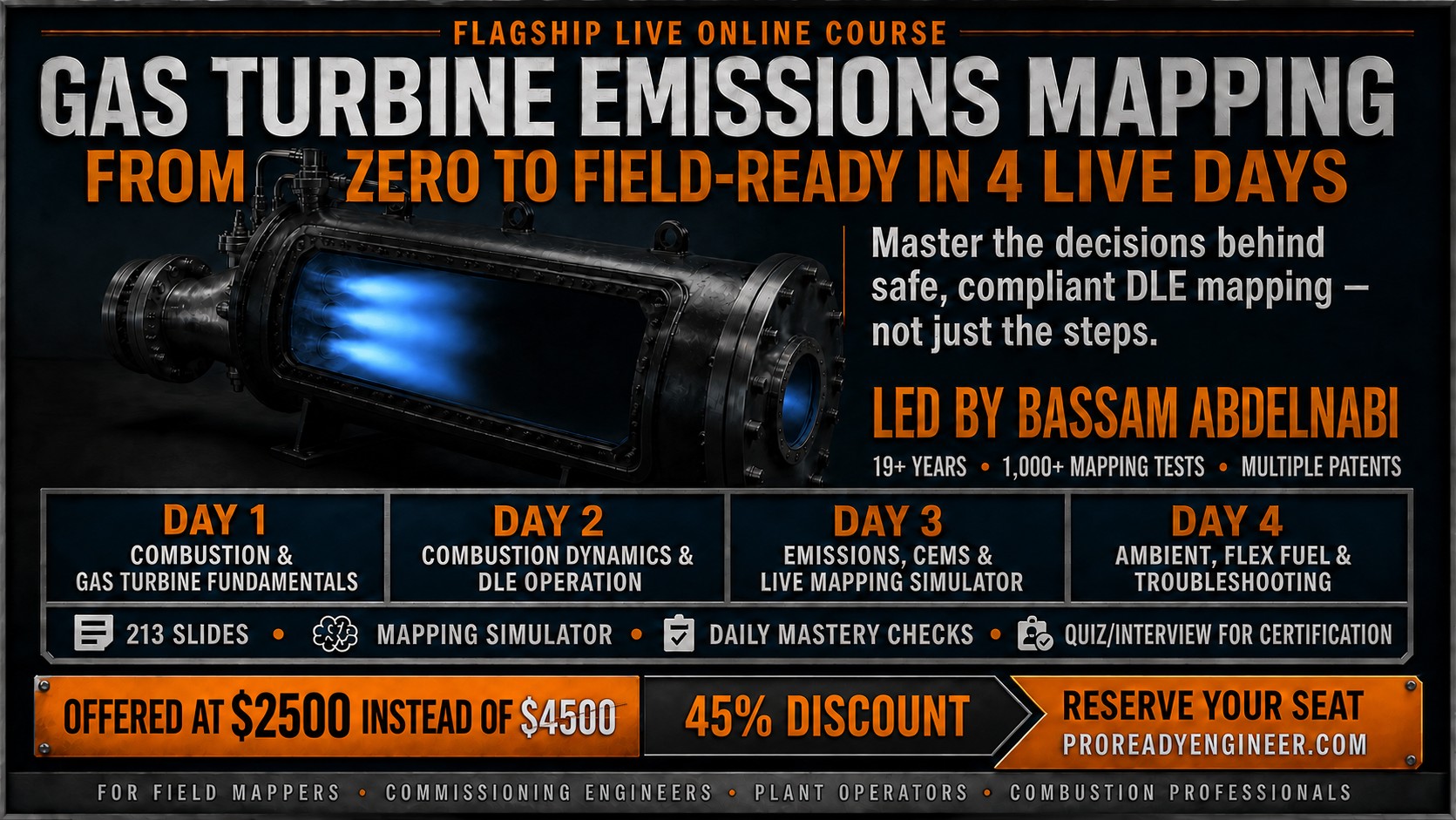
Gas Turbine Emissions Mapping
De-mystify DLE combustion. Master the dynamics corridor, emissions mapping strategy, and flex-fuel troubleshooting from first principles to expert level. No prior gas turbine knowledge required.
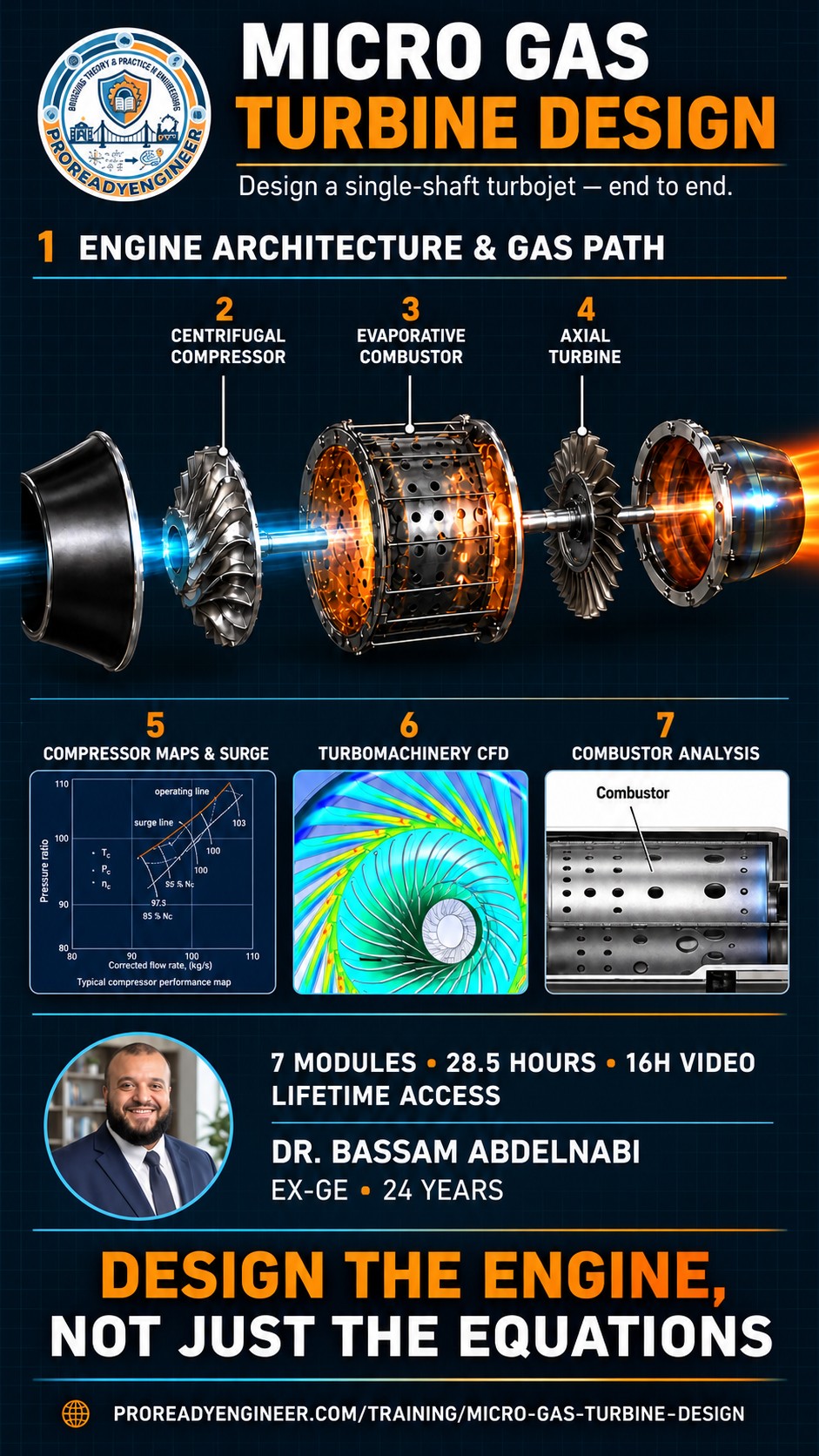
Micro Gas Turbine Design
Design a single-shaft turbojet end to end: architecture, centrifugal compressor, evaporative combustor, axial turbine, compressor maps, CFD and combustor analysis. One curriculum, one set of materials, one certificate, offered two ways. Pick the delivery that fits you.
- Next cohort: November 2, 2026
- 7 Days · live with the instructor
- Registration open
Everything in on-demand, plus 28 live hours with the instructor and direct Q&A as the design unfolds.
Join the Live Cohort- Start today, at your own pace
- 28.5 hrs · 16 h recorded video
- Lifetime access, including updates
The complete course at your own pace: every module, tool and quiz, recorded as delivered.
Start On-DemandSame topics, same depth, same certificate in both formats. Only the delivery differs. For teams, ask us about group registration, licences, or an in-person edition.
- Complete seven-module curriculum and slide decks
- Four design calculators and two interactive tools
- Module quizzes that gate the next module
- Certificate with public verification
Seven Programs in Development
Built from complete course material and decades of field practice. Join a waitlist and we'll email you when a course opens for enrollment; strong waitlists get scheduled first.
Four courses that build on each other: start with pumps, add compressors, then go deep on the seals and valves that keep both running.
Pump Selection, Operation and Troubleshooting
Every major pump type, its curves, its failure modes, and how to select, install, and troubleshoot it.
For: Plant, process, operations, and maintenance engineers who specify or run pumps.
What you'll learn+
- Map the full pump family tree and shortlist the right type for a service
- Choose between centrifugal and positive displacement using flow, pressure, viscosity, and solids criteria
- Read performance curves (head, capacity, power, efficiency) and predict behavior off the design point
- Recognize, predict, and prevent cavitation
- Install pumps properly and lay out pumping stations
- Troubleshoot common pump problems and structure the maintenance response
Outline
- 01Pump families and how to choose
- 02Terminology, curves, and basic theory
- 03Construction and materials
- 04Cavitation
- 05Installation and pumping station design
- 06Troubleshooting and maintenance
Compressor Selection, Operation and Troubleshooting
Reciprocating, rotary, and centrifugal compressors: how they work, how they fail, and how to select the right one.
For: Plant and process engineers in gas processing, refining, petrochemical, and utilities.
What you'll learn+
- Compression fundamentals and the compressor family map
- Rotary positive displacement machines and where they fit
- Reciprocating compressors in depth: construction, operation, and capacity control
- Maintenance and troubleshooting of reciprocating machines
- Dynamic compressor behavior, performance, and operating limits
- A structured selection method for matching compressor type to service
Outline
- 01Introduction and compression basics
- 02Rotary positive displacement compressors
- 03Reciprocating compressors: design, operation, troubleshooting
- 04Turbocompressors
- 05Compressor seals
- 06Compressor selection
Mechanical Seals
From packing and lip seals to dry gas seals: select, install, and troubleshoot the seals that keep rotating machines running.
For: Rotating equipment, maintenance, and reliability engineers who own pumps and compressors.
What you'll learn+
- Classify seal families and pick the right one for a duty
- Read a mechanical seal assembly: pusher and metal-bellows designs
- Select seal support piping plans for flush, quench, and barrier service
- Understand dry gas seals on process compressors, with field case studies
- Install and commission seals to avoid early failure
- Diagnose seal failures from the evidence and apply proven corrections
Outline
- 01Sealing fundamentals and seal families
- 02Packing and mechanical seals
- 03Seal support systems and piping plans
- 04Dry gas seals and case studies
- 05Installation and operation
- 06Troubleshooting, failure causes and corrections
Valve Selection, Operation and Overpressure Protection
Valve types, actuators, and code-compliant overpressure protection, from API practice down to installation and maintenance.
For: Plant, piping, and process engineers responsible for relief devices and valve integrity.
What you'll learn+
- Classify valves by function and construction, and match type to application
- Specify valve actuators and their selection considerations
- Apply ASME and API overpressure protection requirements: MAWP, accumulation, set pressure, blowdown
- Select among spring-loaded, balanced bellows, and pilot-operated relief valves
- Apply pressure sustaining valves in liquid systems
- Install and maintain valves for long service life
Outline
- 01Valve fundamentals, classification and application
- 02Valve actuators
- 03Pressure relief valves
- 04Safety valves
- 05Pressure sustaining valves
- 06Installation and maintenance
A clean arc across three courses: design the combustor, test and evaluate it, then monitor the whole engine in service with a digital twin.
Gas Turbine Combustor Design
Size a combustor and design its diffuser, swirler, fuel injection, and cooling, using the Lefebvre method end to end.
For: Gas turbine, propulsion, and energy engineers who design, modify, or evaluate combustors.
What you'll learn+
- Compare can, turboannular, and annular architectures and state full design requirements
- Size the casing and liner and distribute air among primary, intermediate, and dilution zones
- Design the diffuser, air swirler, and primary-zone aerodynamics that anchor the flame
- Select and size fuel injection, accounting for spray evaporation and fuel properties
- Calculate liner heat transfer and design film cooling within a metal temperature budget
- Predict performance and emissions, carrying a complete design through a working workbook
Outline
- 01Architecture, requirements, and preliminary sizing
- 02Diffuser design and air distribution
- 03Swirler aerodynamics and flame stabilization
- 04Fuel injection and spray evaporation
- 05Liner heat transfer and cooling
- 06Dilution zone, performance, and emissions
Combustion Systems Testing and Evaluation
Measure what actually happens in a combustor: laser diagnostics, spray characterization, emissions, and disciplined test cell practice.
For: Test engineers, combustion R&D engineers, and lab leads who run or interpret rig tests.
What you'll learn+
- Choose the right measurement for the job, and know when optical diagnostics are worth the cost
- Set up and run laser Doppler anemometry: fringe model, seeding, signal processing
- Characterize sprays with phase Doppler: droplet size and velocity distributions, error sources
- Visualize flows with shadowgraphy and PIV, including image processing
- Instrument a combustion test: emissions sampling, gas analysis probes, and data acquisition
- Plan, execute, and report a complete test campaign
Outline
- 01Measurement fundamentals, turbulence, and uncertainty
- 02Point velocimetry: LDA principles and practice
- 03Spray and particle characterization
- 04Flow imaging: shadowgraphy, PIV, image processing
- 05Combustion test cell practice: emissions, probes, DAQ
- 06Planning, running, and reporting a campaign
Building a Digital Twin
Build a working gas turbine digital twin from plant data: physics core, health tracking, wash economics, early warning.
For: Performance, asset management, and digitalization engineers building a condition-monitoring twin.
What you'll learn+
- What a digital twin actually is and the one idea the whole system rests on
- Prepare real plant historian data and fix what is wrong with it before modelling
- Validate instruments first: tell a lying sensor from a failing machine
- Build a thermodynamic model of a specific engine without OEM data
- Track unit condition through health parameters, and know when the system should not trust itself
- Ship capabilities in order: degradation and wash economics, early warning, then diagnosis
Outline
- 01The twin concept and architecture
- 02Plant data and trusting the instruments
- 03The physics core: modelling without OEM data
- 04Health parameter estimation and uncertainty
- 05Degradation, wash economics, early warning, diagnosis
- 06Life accounting and fleet decisions
Courses Beyond the Catalog
The courses listed on this page are only part of what we teach. We also run fundamentals courses that are not scheduled publicly, and we build training to order. Every request is discussed and priced for your team.
Combustion & Emissions Fundamentals
How flames are stabilized and why they blow out or flash back, how NOx and CO form, how DLE and DLN systems control emissions, and what compliance testing actually measures.
For: Operators, technicians, and engineers new to combustion or moving onto DLE units.
Thermal-Fluid Fundamentals
Applied thermodynamics, fluid mechanics, and heat transfer, taught through the equipment plant engineers work with: gas turbines, compressors, combustors, and heat exchangers.
For: Graduate and early-career engineers, and technicians moving into engineering roles.
Testing & Instrumentation Fundamentals
Pressure, temperature, and flow measurement; emissions sampling and gas analysis; data acquisition; and how to plan a test and trust its results.
For: Test, performance, and commissioning engineers and technicians.
Something Else?
Tell us the topic, the level, and who needs it. If it is within our expertise, from gas turbines and combustion to rotating equipment, test facilities, and industrial AI, we will build the course around your team.
Request a CourseEvery course on this page can also be run privately for your team, with content adapted to your equipment.
Plan Training for Your Team
Tell us who needs training, what they need to learn, and where you want it delivered. We reply within one business day with next steps, then send a proposed outline, format, dates, and a quote.
- 1
Tell us about your team
Roles, experience, equipment, and what they must be able to do after the course.
- 2
We propose
An outline, duration, format, location, and a quote. Everything is open to discussion.
- 3
We tailor
Examples and exercises built around your machines, your fuels, and your data.
- 4
We deliver
On site, at a venue, in Cincinnati, or online, in English or Arabic.
للشركات في الشرق الأوسط وشمال أفريقيا
نقدم دوراتنا في موقع شركتكم في أي مكان في العالم، أو في قاعات تدريب احترافية في مدن مثل إسطنبول ودبي والقاهرة، أو في مدينة سينسيناتي بالولايات المتحدة الأمريكية. يُقدَّم التدريب باللغتين العربية والإنجليزية، ويمكن تصميم أي دورة وفق احتياجات فريقكم. تواصلوا معنا عبر هذا النموذج، ويسعدنا الرد عليكم باللغة العربية.
Prefer email? [email protected]